Veruca Salt falls down the rubbish chute
Charlie and the Chocolate FactoryVeruca Salt falls down the rubbish chute when her demand for a trained squirrel turns into a direct violation of Willy Wonka’s rules. In the Nut Room, a workplace organized around sorting good walnuts from bad ones, Veruca herself is treated as a “bad nut”: the trained squirrels test her, seize her, and carry her toward the same chute used for defective walnuts. The episode is both a literal removal from the factory tour and a decisive reversal of the power that Veruca and her parents believe wealth and insistence can command.
Causes and Setting
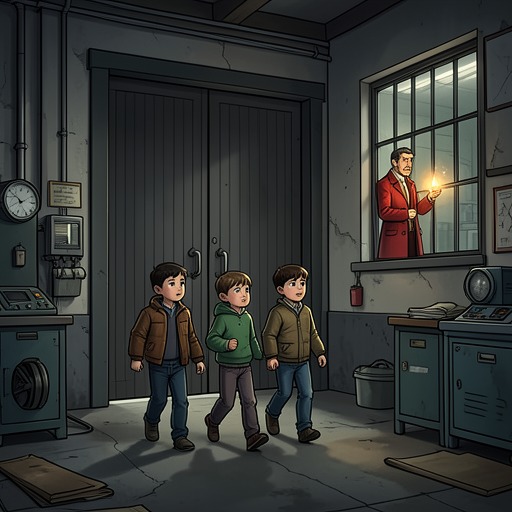
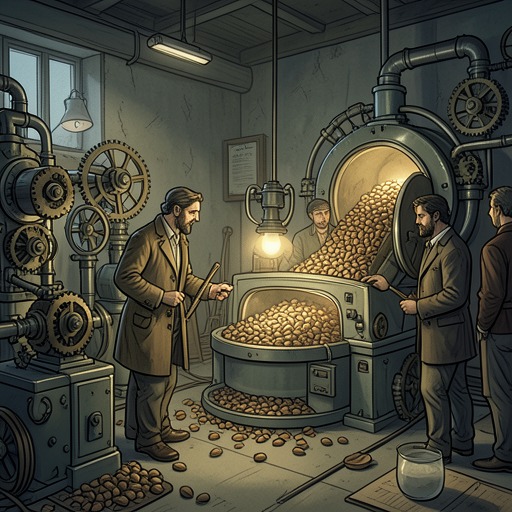
The incident begins at the Nut Room, a place identified by its door and guarded by an unusually clear instruction. Willy Wonka tells the visitors to look through the glass panel but not to enter because they would disturb the squirrels. Inside, one hundred squirrels sit on high stools around a large table, shelling walnuts at tremendous speed. Their work is precise: each squirrel taps a walnut with its knuckles, listens for a hollow sound, and throws a defective nut down a large hole in the floor rather than opening it.
Willy Wonka explains that the factory requires whole walnuts and that the Oompa-Loompas cannot remove them from their shells without breaking them. The squirrels therefore perform a specialized task whose standard is not merely productivity but judgment. They distinguish usable material from waste, and their rubbish chute gives that distinction a visible, ominous destination. The room’s procedure becomes the framework through which Veruca’s own conduct will be interpreted.
Defiance and Escalation
Veruca immediately converts the sight of the squirrels into a new demand. She announces that she wants one, even though she already has numerous pets at home, including dogs, cats, rabbits, birds, a parrot, a turtle, goldfish, white mice, and a hamster. Her demand is not for an ordinary animal but for a trained squirrel, matching the factory’s specialized spectacle with an object she can possess.
Her mother tries to soothe her by promising that she will obtain one as soon as possible, but Veruca refuses this delay. Her father, Mr Salt, treats the matter as a purchase that money can settle. He steps forward with a wallet full of money and asks Willy Wonka to name his price. Wonka answers that the squirrels are not for sale and that Veruca cannot have one. The refusal establishes a boundary that neither wealth nor parental authority can cross.
Veruca challenges the boundary outright, declaring that she will go in and get a squirrel herself. Willy Wonka tells her not to, but the warning comes too late: she opens the door and rushes into the Nut Room. The movement from request to purchase to trespass makes the fall a consequence of escalating disobedience rather than an accidental mishap.
The Squirrels’ Judgment
As soon as Veruca enters, all one hundred squirrels stop working and turn to stare at her. She fixes her attention on a pretty squirrel holding a walnut and reaches out to take it. At that instant, every squirrel leaps toward her like a flash of brown lightning. Twenty-five pin down her right arm, twenty-five pin down her left, twenty-five anchor her right leg, and twenty-four hold her left leg. The remaining squirrel, apparently the leader, climbs onto her shoulder and taps her head with its knuckles.
Mrs Salt screams for her daughter to be saved, but Willy Wonka explains the squirrels’ action through the logic of their work: they are testing Veruca to see whether she is a bad nut. The scene’s dark irony lies in the transfer of a neutral factory procedure to a human being. Veruca has tried to take control of the room, yet the squirrels reduce her to the very category their labor is designed to identify and discard.
The testing ends with a verdict. The squirrels pull Veruca to the ground and carry her across the floor while she kicks and screams. Willy Wonka concludes that she is a bad nut because her head must have sounded hollow. The judgment is presented with the same brisk certainty as the squirrels’ examination of walnuts, turning Veruca’s spoiled behavior into a physical classification and making the factory’s rules seem to act through its animals.
The Chute and the Parents’ Fate
Willy Wonka states that Veruca is going where all the other bad nuts go: down the rubbish chute. Mr Salt watches through the glass door as his daughter disappears toward it, while Mrs Salt’s alarm intensifies when she learns that the pipe ultimately leads to the furnace and incinerator. Wonka adds that there is always a chance the incinerator has not been lit that day, but the reassurance leaves the danger unmistakable rather than removing it.
Mr and Mrs Salt then rush into the Nut Room and peer into the hole. Mrs Salt leans too far over its edge, kneeling with her head down, and the squirrels give her a small push. She topples head first into the chute. Mr Salt responds by leaning forward after her, but the squirrels rush up behind him; he calls for help and falls forward as well. He follows his wife and daughter down the chute, so the incident removes the entire Salt family from the tour.
The episode’s immediate outcome is therefore broader than Veruca’s punishment. Her parents’ attempts to rescue her reproduce the same reckless movement that caused the crisis. Their money, promises, and parental intervention fail in succession, and their efforts to recover control only carry them into the machinery of the factory themselves. Willy Wonka says that someone may catch them at the bottom, but the possibility of the incinerator keeps the consequences suspended between comic expulsion and serious physical danger.
Narrative Function and Significance
Veruca’s descent is one of the factory tour’s elimination events: a child enters a forbidden space, violates an explicit rule, and is carried away by the system she has tried to appropriate. Earlier, the factory tour has been presented as a rare privilege for five children, personally conducted by Willy Wonka and restricted to the lucky holders of Golden Tickets. The wider contest has already turned chocolate into an object of worldwide pursuit, with people buying bars frantically in search of the hidden tickets. Against that atmosphere of acquisition, Veruca’s demand reveals the most aggressive form of possession: she does not merely want the factory’s products but insists on owning part of its living labor.
The Nut Room incident also sharpens the contrast between the children. Willy Wonka later remarks that two naughty children are gone and three good children remain, treating the tour as a process of behavioral sorting. When only Charlie Bucket is left, Grandpa Joe has to call attention to the fact that the other children have disappeared. Veruca’s fall thus contributes to the tour’s hidden competitive structure: the factory’s wonders are also tests, and each child’s response to temptation determines whether that child can continue.
The scene’s value shift is stark. Veruca begins with the apparent power of a wealthy child whose parents habitually promise to satisfy her, and her father even assumes that a price can be named. She ends immobilized, classified as defective, and carried toward waste. The reversal does not depend on a conventional human punishment; it is enacted by the squirrels and the chute, the factory’s own instruments of selection and disposal. In that sense, the event makes the factory’s bizarre logic visible: its marvels are governed by rules, and those rules can become merciless when a visitor mistakes access for ownership.